Beyond the kids’ table: Reflections of the EHL Youth Event
“If they don’t give you a seat at the table, bring a folding chair.”
— Shirley Chisholm
The line is usually understood as a demand for access: if there is no place for you where decisions are being made, make one. After the European Heritage Label (EHL) Youth Event in Bucharest, though, I kept thinking about what happens after the folding chair arrives. Having a seat matters, but it does not automatically mean having a say -or having any role in deciding what is on the menu. That, for me, is where the more difficult conversation about youth participation begins.
The Invitation Illusion
Heritage is often discussed through the language of inheritance. It is what previous generations leave to us, what we have a responsibility to protect and what should eventually be passed on to those who come next. There is nothing wrong with that understanding, but it can make heritage sound strangely predetermined, as though the stories have already been selected, their meanings settled and the task of younger generations is simply to receive them. In reality, heritage is constantly being interpreted in the present. Which stories are given space, whose memories become visible, how a site communicates and who is made to feel that a place belongs to them are all choices. Once we look at heritage in this way, youth participation becomes a much bigger question than how to attract more young visitors or make heritage institutions feel more relevant to them.
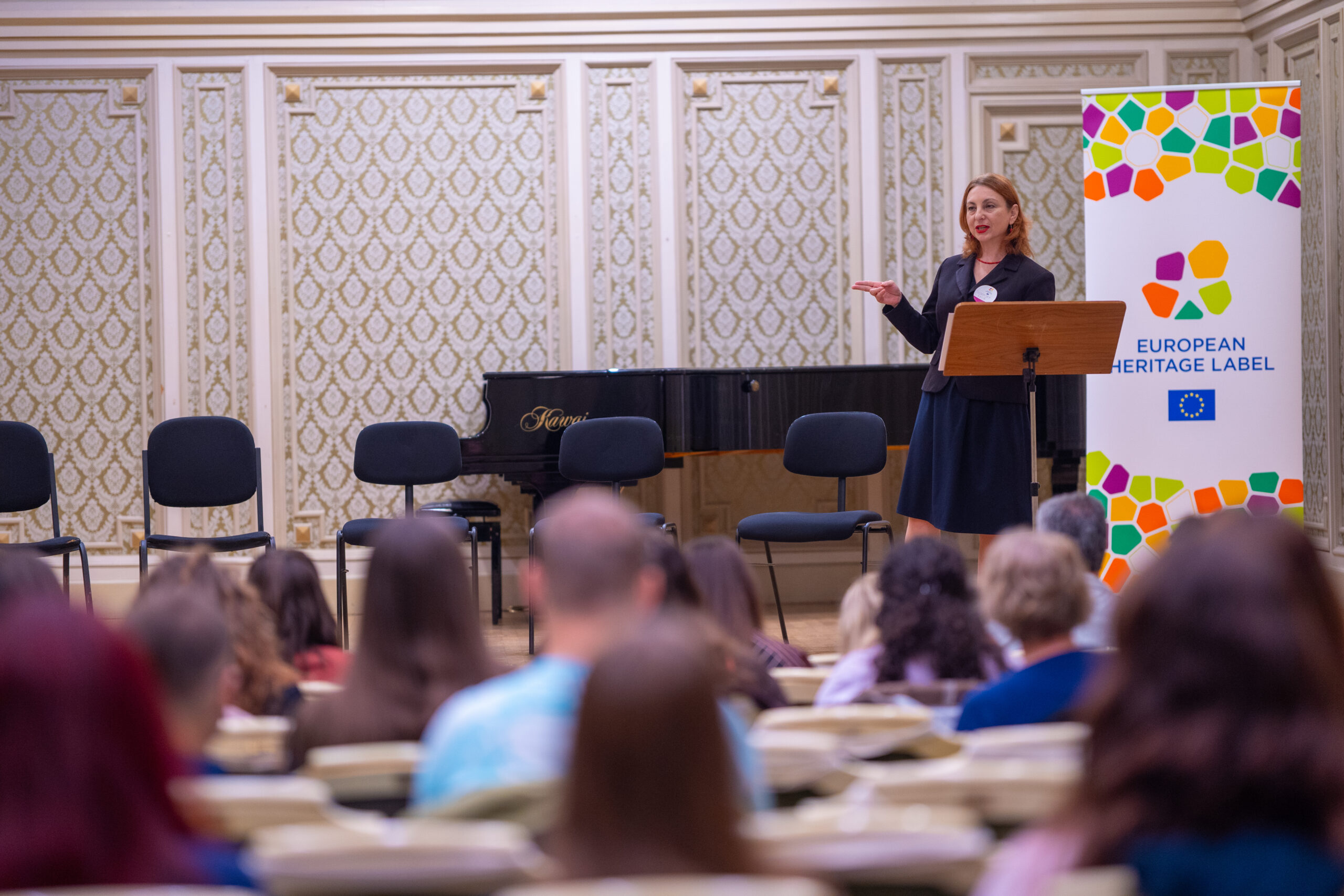
This was one of the issues running through the EHL Youth Event in Bucharest. Young people, representatives of EHL sites and members of the wider EHL community came together to discuss participation, communication, accessibility and continuity, and then to turn those discussions into ideas through workshops and co-creation sessions. The intention was not for the event to stand alone, but to contribute to longer-term collaboration between young people and Romanian EHL sites. What became clear quite quickly was that the familiar assumption that “young people are simply not interested in heritage” does not take us very far. The barriers discussed were much more practical and structural: information does not always reach young people, opportunities are concentrated in larger cities, transport and cost matter, time matters, and many young people simply do not know what they can concretely do beyond attending or visiting.
The pre-event survey also pointed to a more fundamental problem. Several respondents had participated in activities, volunteered or been asked to provide feedback without feeling that they had been involved in actual decision-making. Some described consultation taking place only after the important choices had already been made. The positive experiences were different: young people had been trusted with a task, given responsibility and able to see that their judgement had some effect on the work. This may seem like a small distinction, but it is probably the central one. Being present is not the same as participating, and being consulted is not necessarily the same as having influence.
This is hardly a new problem in participation theory. Roger Hart‘s influential work on children’s participation (1992), which has since become a key reference in wider debates on youth participation, distinguished tokenistic involvement from more meaningful forms, including shared decision-making with adults. More than three decades later, the Council of Europe’s newly revised European Charter on the Participation of Young People in Local and Regional Life (2025) still places the ability to influence decision-making at the heart of meaningful participation.
The kids’ table dilemma
That brings us back to the kids’ table. Dedicated youth boards, consultations, youth events and workshops do matter. I say this as someone who participates in youth advisory structures myself. They can create an environment where younger participants have space to test ideas, develop confidence, meet others with similar interests and speak without first having to understand every hierarchy and unwritten rule of an established institution. They can also correct an imbalance that already exists: young people do not enter institutional spaces with the same professional position, networks, resources or familiarity with the language of cultural organizations as people who have worked in the sector for twenty years. The problem begins when the youth space becomes a parallel space: a place where young people are invited to talk about “youth issues”, produce recommendations and generate ideas, while decisions about programming, resources, interpretation and institutional priorities continue to be made somewhere else.
If we extend the table metaphor just a little further, the question is therefore not only whether young people receive a chair. It is whether they have any role in shaping the menu. One of the most interesting findings in the Bucharest survey was that respondents did not simply ask to be listened to more often. They wanted involvement earlier in the process, opportunities to develop and implement their ideas, visible outcomes and feedback explaining what happened to their proposals. They also wanted regular dialogue rather than isolated consultation. These are fairly concrete expectations and they shift the conversation from voice to influence. An institution can listen very carefully to young people and still change nothing.
Who gets to write the menu?
We tried to put some of this thinking into practice in the workshop on Sustainable Tourism at EHL Sites, which I co-facilitated with Kristina Simončič. Rather than asking participants whether they liked an existing cultural offer, we asked them to work as designers. Using the Romanian Athenaeum, the Sighet Memorial and the Palace of the European Commission of the Danube as starting points, each group had to identify something that could genuinely make a young person care about the site and then develop an experience around it. The important question was not simply what information should be communicated, but what a young person would actually do: discover something, create something, question an established interpretation, follow a story or contribute their own perspective. The ideas were then tested against environmental sustainability, mobility, social inclusion, cultural integrity and, importantly, continuity: could the activity still exist after the initial enthusiasm and funding had passed?
The exercise was small and deliberately fast, but the change of perspective was useful. Young people were no longer being asked only how institutions could communicate better to them. They were being asked what institutions might create with them. That difference also matters for communication. Social media came up repeatedly in the survey and discussions. Of course, cultural institutions need to communicate through channels young people actually use. But treating youth engagement primarily as a communication problem can become another shortcut. A stronger social-media presence might make an institution more visible; it does not automatically make it more participatory. The deeper issue is whether young people can help shape the story, the activity or the decision behind the post.
The participation trap
So should youth participation eventually stop being a separate category? I think the answer is yes, but with an important qualification. Mainstreaming youth participation cannot simply mean removing dedicated youth structures and declaring that everyone now participates equally. The discussions in Bucharest made clear how unequal the starting conditions still are. Geography, transport, financial resources, professional status, access to technology, confidence and available time all shape who can participate. Your chance of becoming involved looks very different if you live close to a major cultural institution than if reaching an event requires several hours of travel; volunteering also looks different when you can afford to give your time freely than when you cannot. The plenary discussion even returned to the need to combine digital methods with more traditional forms because access to technology cannot simply be assumed. These are not marginal practical issues. They are part of the participation question itself.
Perhaps, then, dedicated youth structures should be understood as scaffolding rather than an annex. Their purpose is not only to create a protected youth space, but to build routes into the rest of the institution. A youth advisory board should be connected to ordinary decision-making rather than consulted only on explicitly youth-related topics. A consultation should eventually produce a response. Someone who helps design an initiative should, where possible, have the chance to be involved in developing or implementing it. And if an institution cannot adopt an idea, explaining why is itself part of taking participation seriously. The objective is not to turn every young participant into an institutional decision-maker overnight, but to make the relationship between contribution and outcome visible.
This matters particularly in cultural heritage because heritage institutions exercise a form of authority every day. They decide what is preserved, how it is interpreted, which stories are foregrounded, what vocabulary is used and which communities are invited to recognize themselves in the past. Those decisions are never entirely neutral. If young people are only asked to make the final product more attractive to their peers, they enter the process very late. If they can also participate in discussing what the story is, why it matters now and how it should be experienced, then participation begins to reach the substance of heritage rather than only its promotion.
The European Heritage Label has an interesting opportunity in this respect because it is already a network built around the relationship between local places and wider European stories and values. That network can also be used to experiment with different forms of participation. There does not need to be a single youth-engagement model reproduced identically across Europe. What can travel are methods: ways of involving young people earlier, giving them responsibility, connecting them with site professionals and allowing an idea developed in one place to inspire something different elsewhere. This was also part of our workshop, where participants were asked whether the approach they had designed for one Romanian EHL site could be transferred to another site while keeping its own local story intact.
The morning after
For this reason, the real test of a youth event may begin when everybody goes home. It is relatively easy to create energy for two days and Bucharest certainly had plenty of it. The harder questions come afterwards: Does one of the ideas move forward? Does somebody tell participants what happened to their recommendations? Is there a route for a young person to remain involved with a site? Does a youth board contribute to conversations that are not labelled “youth”? Does the institution itself learn something and change the way it works? The survey points towards a simple but quite demanding shift: away from young people as audience and towards young people as partners.
I do not think this means doing away with youth boards, youth events or dedicated opportunities. We still need them and probably will for some time. But their success should not be measured only by how many young people attend or how many ideas are collected. A stronger measure would be whether they make the main table easier to enter and whether, once there, young people can influence some of what happens around it. Perhaps the point at which youth participation has really succeeded will be when young people no longer need to be invited into every room specifically as young people, because their perspectives, knowledge and involvement have become an ordinary part of how cultural heritage is understood and governed. That would be more than giving young people a chair. It would mean recognizing that they also have something to say about what the table is for.
Article by Athina Fatsea