La Nau Cultural Centre

Entrance to the Centre Cultural La Nau through the Patriarch Square | Eduardo Alapont © Universitat de València
The facade presents a sober neoclassical composition, with two wide levels and a powerful cornice that crowns and surrounds the perimeter of the building.
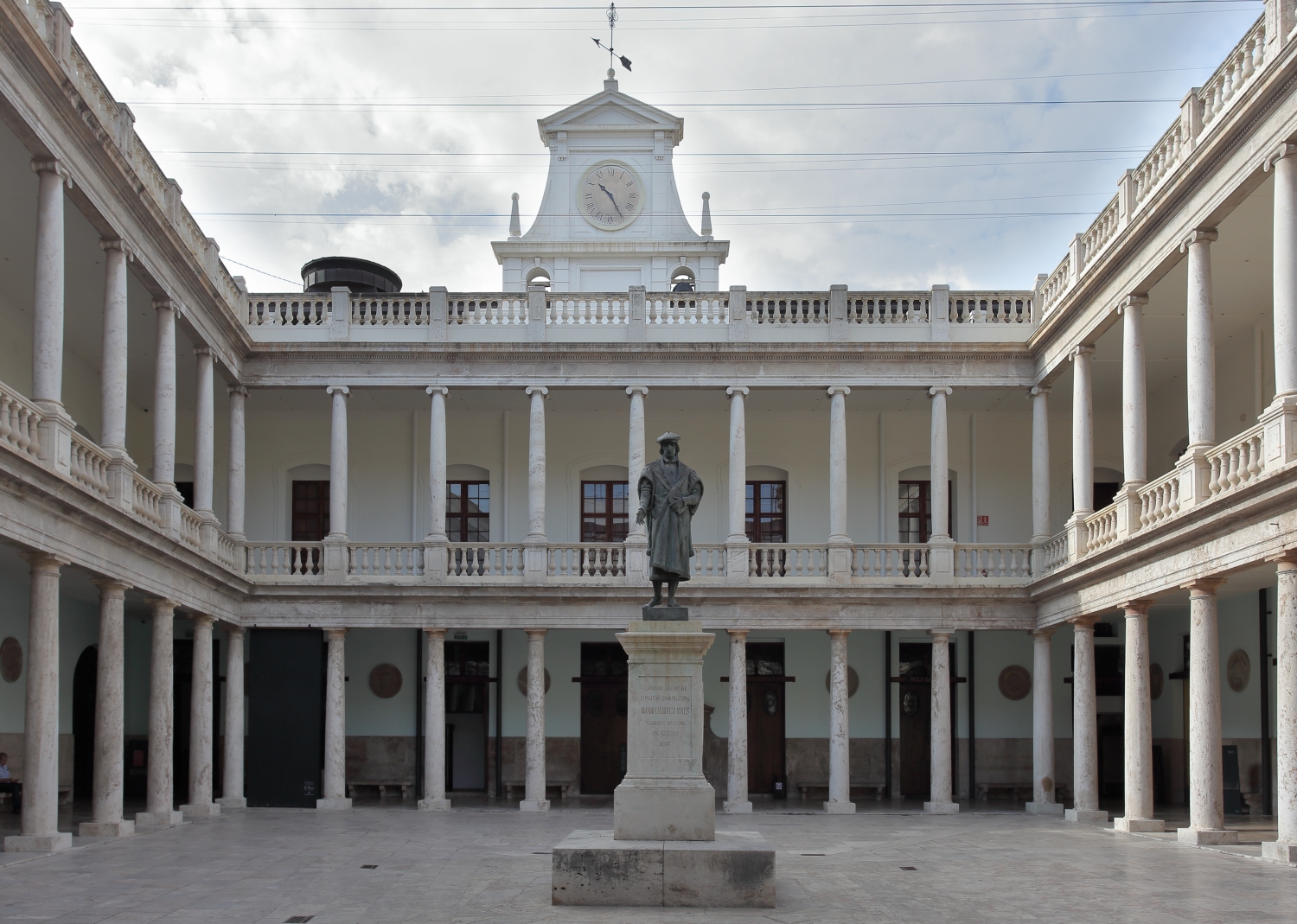
Main cloister of the Centre Cultural La Nau | Eduardo Alapont © Universitat de València
The center is presided over by the sculpture of the humanist thinker Luís Vives, made in 1880 by the Valencian sculptor José Aixa Íñigo at the request of the Rector José Monserrat.
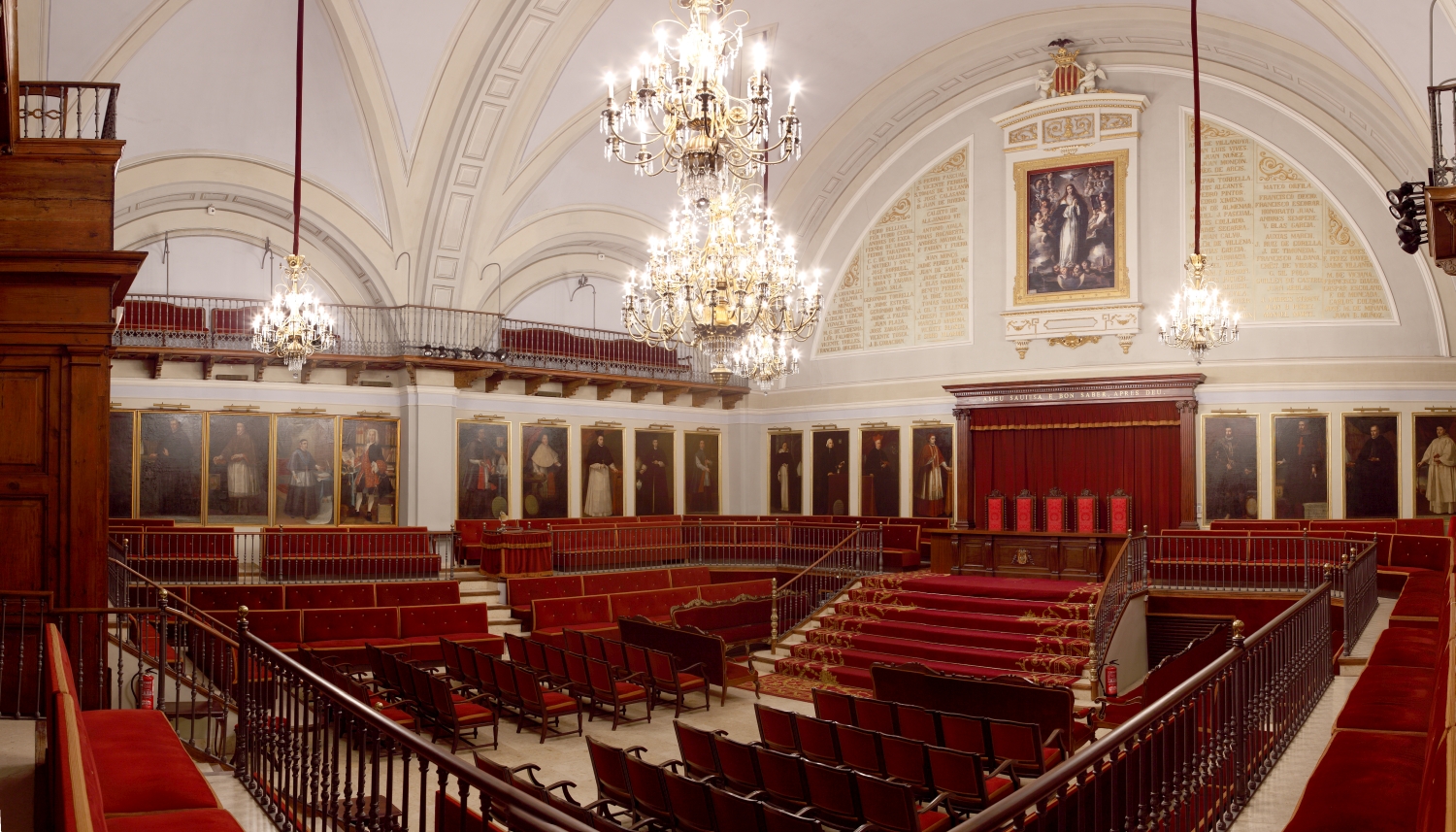
The Paraninfo (or Academic Theatre) of the Centre Cultural La Nau | Eduardo Alapont © Universitat de València
Its first construction dates back to the 17th century, when university students performed classical comedies in Latin and Greek there. After an
initial renovation in the 18th century, a complete overhaul was carried out in 1869 by the Valencian architect Sebastià Monleon i Estellés, giving it
its current appearance. The space is dominated by a painting of the Immaculate Conception by Jerónimo Jacinto de Espinosa, created in
1660.

The Chapel of Wisdom of the Centre Cultural La Nau | Eduardo Alapont © Universitat de València
It was built by Pere Compte in 1498. Three centuries later, in 1737, this space was completely rebuilt by the architect Miguel Martínez. Of
particular note are the high-quality paintings and sculptures it houses, including the altarpiece of Our Lady of Wisdom, painted in oil by Nicolás
Falcó in 1516, and the image of Saint Bruno Abbot, created in 1750 by the Valencian sculptor Ignacio Vergara.
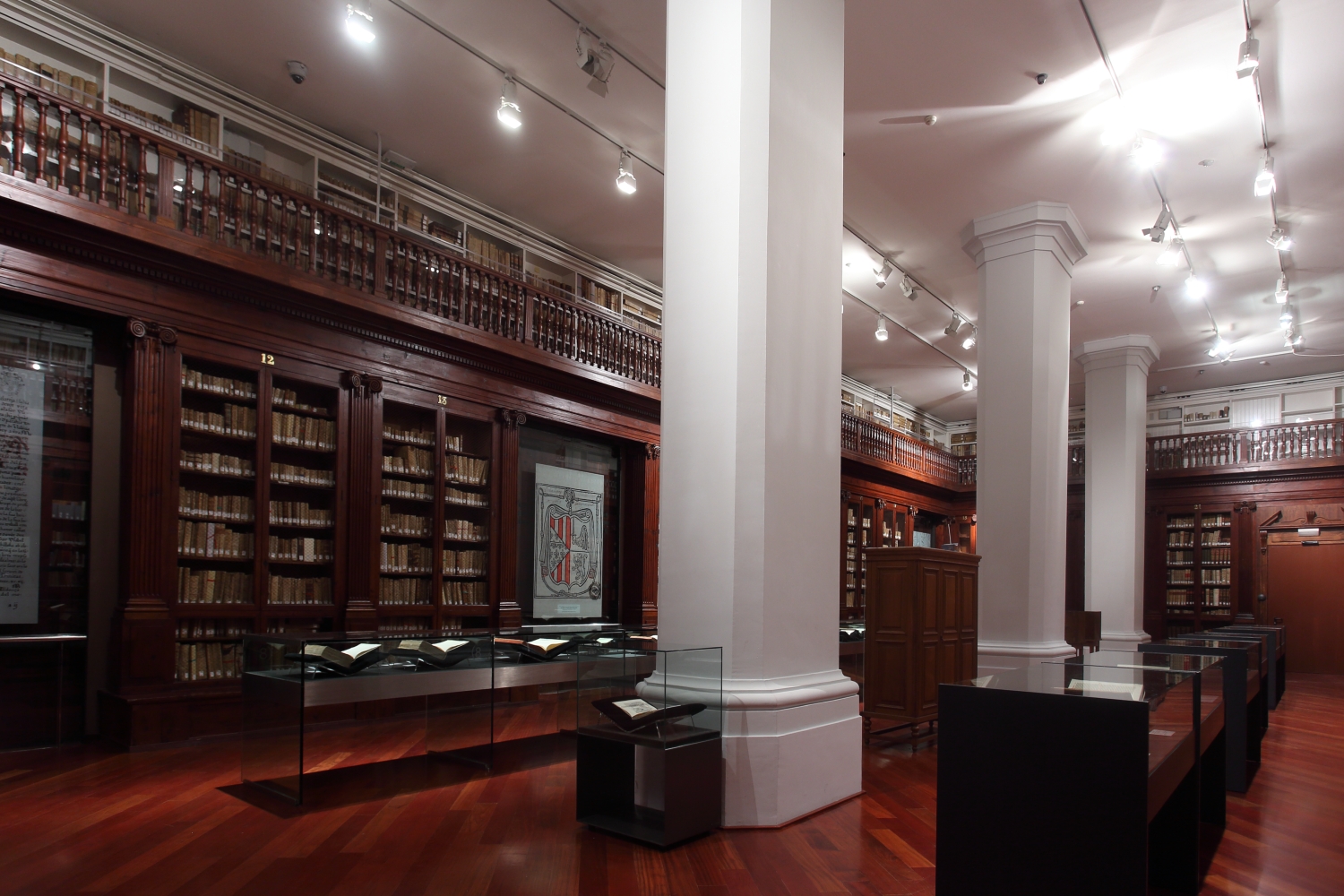
The Duke of Calabria Room, of the Historical Library of the Universitat de València | Eduardo Alapont © Universitat de València
This room in the historical library of the Universitat de València houses historical manuscripts and incunabula of great prestige and quality.
The EHL Site
La Nau Cultural Centre is the historic headquarters of the Universitat de València, which was founded on this very site in 1499 in the spirit of Renaissance humanism. In 1999, following the celebration of its five centuries of history, this historic building was transformed into a Cultural Centre with the aim of disseminating the cultural heritage of our university, as well as managing the institution’s cultural activities. To this end, the building preserved the former Rectorate offices, the Chapel of Wisdom, the Paraninfo (or Academic Theatre), and the Historical Library, with its more than a thousand manuscripts and 350 incunabula, among which the collection of the Duke of Calabria stands out.
In addition, its two arcaded cloisters house theatres, exhibition spaces, and other areas dedicated to cultural and educational activities with an intergenerational approach, focusing on new generations of young people and students. This is achieved through nine classrooms designed to enhance understanding of Europe’s shared history through the study and rigorous cultural and scientific dissemination of its rich and diverse cultural heritage, a key element of historical memory and shared cultural identity, so essential for processes of social cohesion and resilience.
These nine classrooms are dedicated to: Performing Arts, Visual Arts, Film, Comics, Gastronomy, Democratic Memory, Narrative, Music, and Poetry. These classrooms develop annual programs of cultural activities for educational purposes, aimed at the university community and the general public. These programs will continue to be promoted in the coming years. Intergenerational, inclusive, and flexible approaches are prioritized, in line with the Recommendations adopted by the Council of the European Union on June 16, 2022, to promote lifelong learning, thus contributing to building a Europe of knowledge and opportunity, with a particular focus on young people.
European Dimension
The European dimension of the La Nau Cultural Centre and its capacity to foster diverse cultural networks is evident in initiatives such as Escena Erasmus, which has been awarded the European Charlemagne Youth Prize by the European Parliament, among other local, national, and international accolades. Escena Erasmus leverages the potential of the performing arts to bring together European Erasmus exchange students and students from the University of Valencia. In turn, Escena Erasmus connects Europe from the university to the surrounding region through the ‘Little Europes’ project, which promotes the founding values of the European Union in rural areas.
The La Nau Cultural Centre of the Universitat de València also fosters this European dimension through its participation in and leadership of projects funded by the ‘European Commission and the Council of Europe. An example of this is the project Novel technologies for on-site and remote collaborative enriched monitoring to detect structural and chemical damages in cultural heritage assets’ (ChemiNova, 2024-2027), funded by the European Commission and coordinated by the Universitat de Valècnia. Its objective is to revolutionize cultural heritage conservation practices by creating an intelligent computer system that gives special consideration to structural and chemical damage caused by climate change and civil conflicts.
Finally, this same European dimension is strengthened through the International Association Aromas Itinerarium Salutis (AIS) and the European Route of Historic Pharmacies and Medicinal Gardens, declared a Cultural Route of the Council of Europe in 2024, whose founding headquarters in 2021 was the La Nau Cultural Center of the Universitat de València. AIS represents a consortium of twelve European countries, with an openness to Latin America
(including Argentina), bringing together Bosnia and Herzegovina, Bulgaria, Croatia, Spain, France, Hungary, Italy, Lithuania, Poland, Portugal, Romania, and Switzerland. Its objective is to promote annually research, awareness-raising, development education, and sustainable cultural tourism activities focused on highlighting materia medica as an ancestral and cultural heritage with a high capacity to promote historical memory, environmental sustainability,
biodiversity, and fruitful intercultural dialogue in Europe and Latin America, in accordance with the democratic values of the Council of Europe’s Cultural Routes Programme.
The organization
La Nau Cultural Centre is a hub of artistic and cultural activity throughout the year. So much so that its programming must be finalized at least two years in advance in areas such as exhibitions, which foster:
(a) the exchange and convergence of local, national, and European artists in our historic building.
(b) intercultural debates surrounding the exhibits, generally focused on current issues ranging from the territorial to the European (global warming, climate change, energy transition, democracy, human rights, equality, etc.)
Contemporary art, through these exhibitions and the debate cycles they generate, strives to address and provide answers to today’s world, in constant change and transformation. This commitment of La Nau is also expressed through its Classrooms (Performing Arts, Film, Comics, etc.), and in specific calls that, like “Activa Cultura”, not only promote from contemporary culture and creation the debate and critical reflection of our present, evoking pasts and building futures under the paradigm of European democratic values, but also invite the youngest artists to be its spokespeople.
In this sense, the activities promoted annually by the La Nau Cultural Centre place great importance on young people, not only as recipients of culture, but also as its drivers through contemporary creation. Throughout the year, for example, university students not only visit the exhibitions, concerts, competitions, film series, dance and theatre performances, etc., organized and promoted by La Nau’s classrooms, but also propose and coordinate certain
cultural, educational, and artistic outreach activities. This makes them valuable cultural spokespeople, since only through a plurality of voices—including those of the new generations—can we understand today’s Europe and participate in its changes.