Landeszeughaus Graz



The EHL Site
The origins of today’s Styrian Armoury in Graz can be traced back to the mid-17th century. At that time, the Duchy of Styria was part of the Habsburg power complex and lay on the south-eastern external frontier of the empire. From the 15th century onwards this region was afflicted with continuous supraregional conflicts between the Habsburgs, Hungary and the Ottoman Empire, which was expanding in the direction of Central Europe.
In order to prevent any further expansion of the Ottoman Empire, by the early 16th century the Habsburg Empire had begun to establish the “Military Frontier” as a cordon sanitaire. The administrative management of part of this Military Frontier, located in today’s Croatia, was handled from Graz. For this purpose, the present-day Styrian Armoury was commissioned by the provincial estates and set up between 1642 and 1647.
As armed conflicts abated in the region, the armoury became less important. In 1749, Maria Theresia introduced a reform to centralise the armed forces. She ordered all weapons to be transported to Vienna. Following objections by the Styrian estates, however, the armoury in Graz remained intact. Maria Theresia allowed the Styrians to preserve the building as a “monument to the history of the region and the bravery of their ancestors”. In 1882, the armoury opened its doors to the general public for the first time. Ten years later, it was absorbed into the Joanneum.
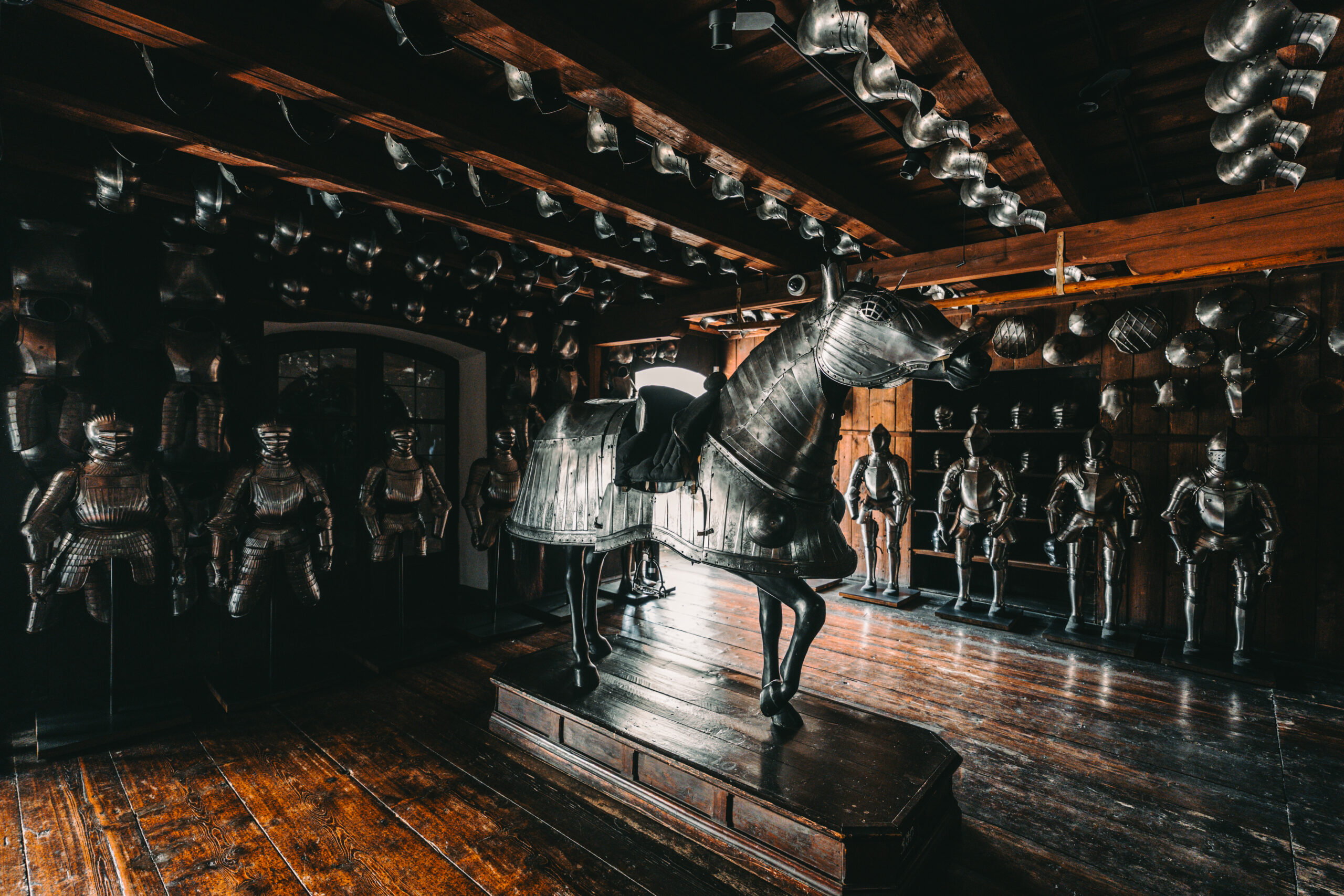
The Graz Armoury was designed as a plain, functional building. Spread over four storeys and an area of 2,000 m2, the arrangement of the military equipment followed practical criteria and aimed at maximum use of space. The heavy guns were stored on the ground floor. Rifles, pistols, suits of armour, spears, etc. were kept on the upper floors on shelves, gun racks, ceilings and walls.
Today, the Landeszeughaus is the largest preserved historic armoury in the world, with some 32,000 weapons and pieces of military equipment. It attracts tens of thousands of visitors from Europe and all over the worldevery year.
European Dimension
For many, the armoury is a central monument to the regional history of Styria and testimony to a time of heavy conflict. However, it is equally significant in the context of modern European history and its role within a network that emergedat that time in Central and Southeast Europe. For centuries there were armed conflicts in this area, causing the movement of people, goods and ideas: hence weapons made in Austria and Germany were transported via Graz to the Military Frontier in what is now Croatia. Apart from Styrian soldiers, it was mainly “soldier-peasants” who had fled the Ottomans and arrived from the Balkans, together with mercenaries recruited from various regions of Europe, who performed military service there. Italian architects planned the fortification of the cities, while Dutch experts were involved in the mapping of the region. Successes against the Ottoman Empire, which had extended its sphere of influence as far as Hungary and Bosnia, were only made possible by a common European defence policy that led to alliances and mutual assistance.
An important intersection in this European network was the Landeszeughaus, which was, incidentally, designed by a Swiss architect. Its holdings reflected many different European stylistic developments and weapons technologies. In this environment, plans were forged and strategies defined. The Styrian Armoury became obsolete at the moment that standing armies were established in Europe, and an idea that is now central to Europe gradually gained in importance: peace. This drove the expansion of transport routes and economic relations. Legations and embassies were established. People began to travel, returning with changed impressions of the “other”. An important foundation for these developments was the “Treaty of Passarowitz” (now Požarevac in north-eastern Serbia), in which two previously hostile neighbours – the Habsburg and Ottoman Empires – reached agreement.
The organization
As part of the Department of Cultural History, the Landeszeughaus belongs to the Universalmuseum Joanneum, Austria’s oldest and second largest museum. It was endowed to the province of Styria by Archduke Johann in 1811 and today its collection comprises some five million objects. In 2003, the Joanneum was transformed into a non-profit limited company. The Joanneum currently encompasses 20 museums in and outside Graz and a zoo. The Universalmuseum is funded by the Province of Styria, which also provides the museum’s main funding.