Universitat de València Takes Centre Stage at FILUNI 2026 in Mexico
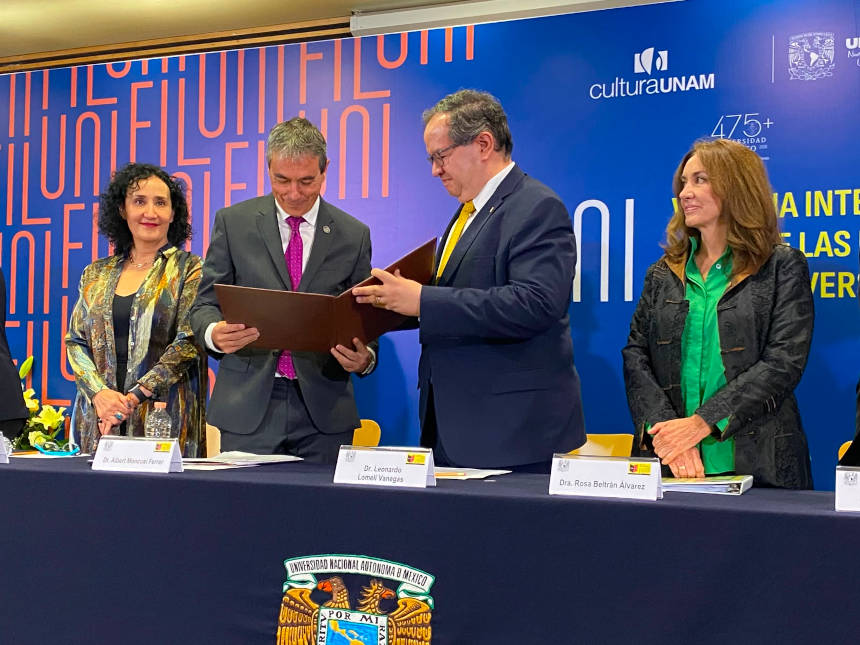
From 25 to 30 August 2026, the Universitat de València took centre stage at the eighth edition of the International Book Fair of University Students (FILUNI) in Mexico City. Invited as the fair’s guest of honour, the university presented the most comprehensive international programme it has developed to date.
Organised by the National Autonomous University of Mexico (UNAM), FILUNI brought together 350 publishing houses and around 20,000 works, creating a major meeting point for university publishing, knowledge and cultural exchange.
For the Universitat de València, the invitation provided an opportunity to present much more than its publishing activity. Across six days, its programme combined university publishing, bibliographical heritage, exhibitions, cinema, music, workshops, academic debate and scientific dissemination, reflecting the different ways in which universities contribute to culture and society.
As Universitat de València Rector Juan Luis Gandía highlighted, the invitation recognised both an institution with more than five centuries of history and its university publishing house, Publicacions de la Universitat de València, established in 1920. The programme reflected a shared understanding between the two universities that their role extends beyond research and education to include creating culture, preserving heritage and fostering critical thinking.
Building bridges between València and Mexico
The collaboration between the Universitat de València and UNAM placed particular emphasis on the historical and cultural connections between Spain and Mexico.
Five books co-published by the two universities explored these shared histories, including the experiences of Spanish Republican exiles Manuela Ballester and Josep Renau, whose lives and work were shaped by Mexico’s reception of Spanish intellectuals. Other publications explored Mayan culture and the Popol Vuh, as well as culture as a space for freedom through the international congresses of intellectuals held in València in 1937 and 1987.
The wider cultural programme featured almost 50 activities, ranging from book presentations and panel discussions to workshops, screenings, recitals and concerts. Topics included climate change, democratic memory, cultural heritage, minority languages, scientific dissemination and the recovery of the book sector following the DANA floods of October 2024.
Bringing university heritage to an international audience
Heritage also occupied a prominent place in the programme. The Universitat de València’s Historical Library travelled to Mexico with the exhibition Ink, Parchment and Paper. Treasures of the Historical Library of the Universitat de València (15th–17th centuries), presenting part of the university’s bibliographical heritage to an international audience.
Other exhibitions explored the social memory of the DANA and the history and cultural role of La Nau, the university’s historic cultural centre and part of the European Heritage Label Site.
The programme also included a tribute to filmmaker Luis García-Berlanga, with screenings, conferences, a concert and educational activities dedicated to his cinematic legacy.
Beyond the fair itself, the Universitat de València co-organised international meetings on university publishing, libraries, university bookshops and authors’ rights. Discussions addressed emerging and shared challenges including open access, artificial intelligence, the circulation of knowledge and the preservation of documentary heritage.
Through this extensive programme, FILUNI 2026 offered the Universitat de València an international platform to connect its heritage, research and cultural activity with new audiences, while strengthening academic and cultural cooperation across the Ibero-American community.